Decentralized Local Infrastructure Network (DLIN™) — connecting edge deployments into a high-capacity, resilient digital utility fabric engineered for energy-efficient, high-density computing.
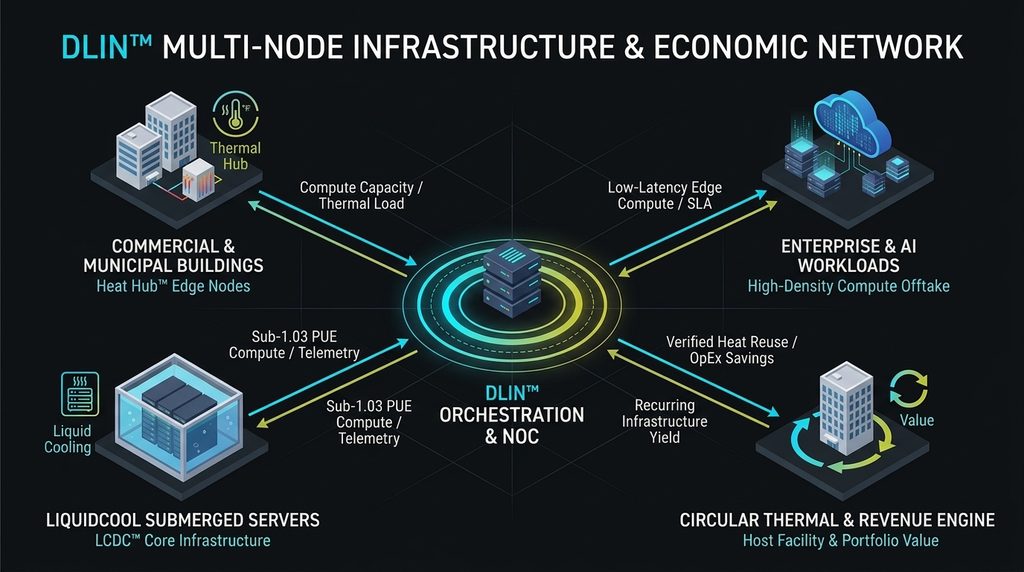
We built the Decentralized Local Infrastructure Network (DLIN™) to turn standalone Heat Hubs™ into an interconnected, regional digital utility fabric—linking qualified commercial, municipal, and utility-connected buildings into a single, orchestrated edge compute and thermal recovery grid.
Instead of sinking hundreds of millions of dollars into greenfield land, multi-year utility queues, and conventional chiller plants, we deploy modular, high-density LiquidCool Submerged Server (LSS) nodes directly inside existing building mechanical rooms. From our Network Operating Center (NOC), we dynamically balance enterprise and AI compute workloads against each host facility’s live thermal demand—eliminating district piping overhead while turning idle square footage into active infrastructure.
Operating as an affiliated, licensed-IP distributor of LSS technology, Fiberoptiq pairs disciplined operational execution with capital-efficient infrastructure economics across domestic real estate portfolios. Every connected node unlocks dual-sided value: enterprise clients gain ultra-low-latency, sub-1.03 PUE edge compute, while building owners capture verified waste-heat reuse, lower mechanical OpEx, and recurring network yield. By scaling incrementally node by node as demand grows, DLIN™ bypasses speculative mega-campus CapEx and transforms distributed urban buildings into a resilient, revenue-generating compute grid.
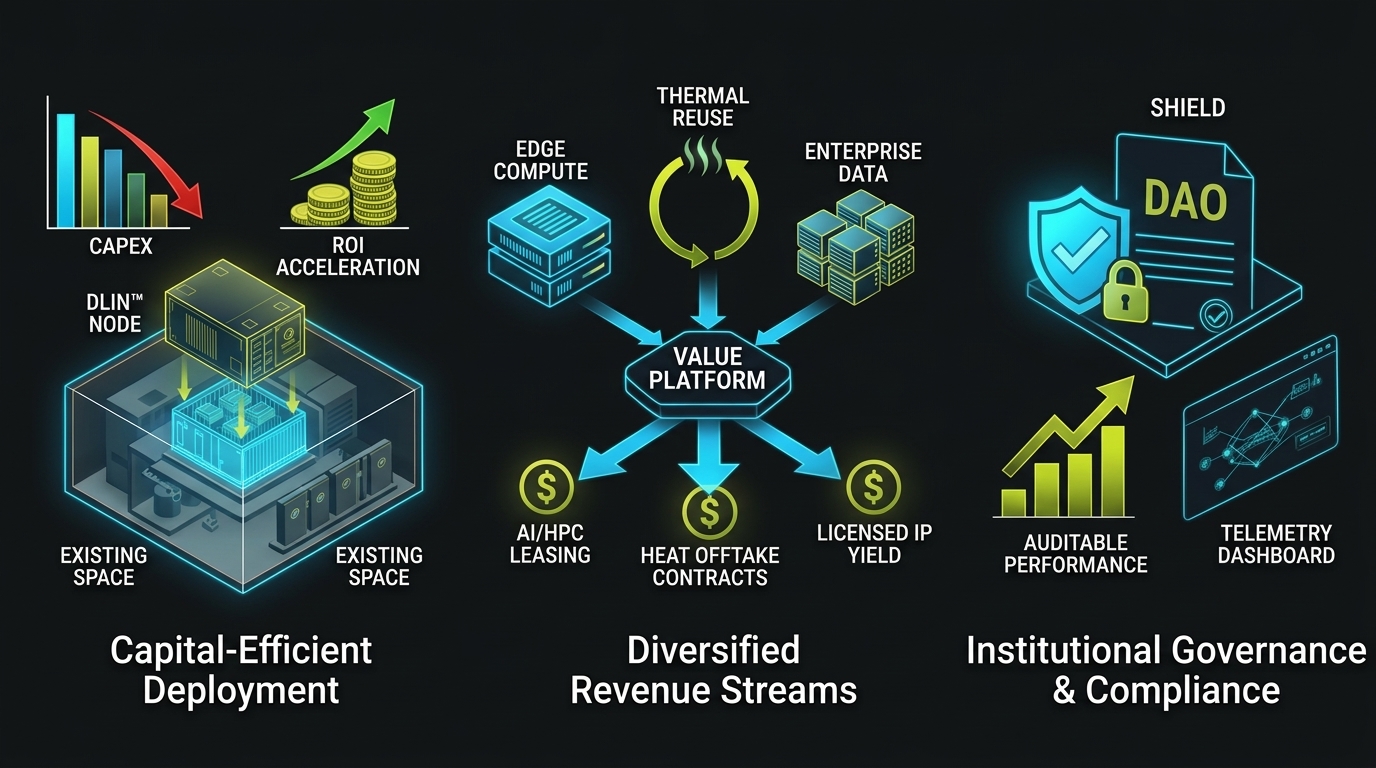
The 3-Pillar Value, ECONOMIC, & COMMERCIALIZATION ENGINE
We don’t build billion-dollar greenfield campuses—we scale capital-efficient, revenue-generating edge nodes inside existing real estate.
Capital-Efficient Deployment
Execute multipoint Proof-of-Concept (PoC) deployments to retrofit existing mechanical rooms in 4–12 months—bypassing multi-year greenfield builds. Each connected node converts underutilized building space into a high-yield, diversified revenue asset. Across domestic portfolios, Fiberoptiq monetizes this distributed network capacity through high-density AI/HPC compute leasing, circular thermal-energy optimization, enterprise hosting, and licensed-IP deployment.
Diversified Revenue Streams
Each connected node transforms idle building space into a diversified revenue-generating asset. Across domestic portfolios, Fiberoptiq monetizes network capacity through four core channels: high-density AI/HPC compute leasing, circular thermal-energy optimization, enterprise and government hosting contracts, and licensed-IP deployment.
Institutional Governance & Compliance
Every DLIN™ node is built to meet the rigorous demands of enterprise, utility, and public-sector deployments—combining carrier-grade 95%+ uptime, hardened cybersecurity controls, real-time telemetry, and automated failover protocols. By integrating Decentralized Autonomous Organization (DAO) alignment alongside compliant Regulation D frameworks, we deliver structured governance and auditable performance benchmarks for accredited investors and institutional partners.
Economic Core: Transforming qualified commercial, municipal, and utility-connected buildingsfrom isolated energy Consumers into Fiberoptiq’s DLIN™.
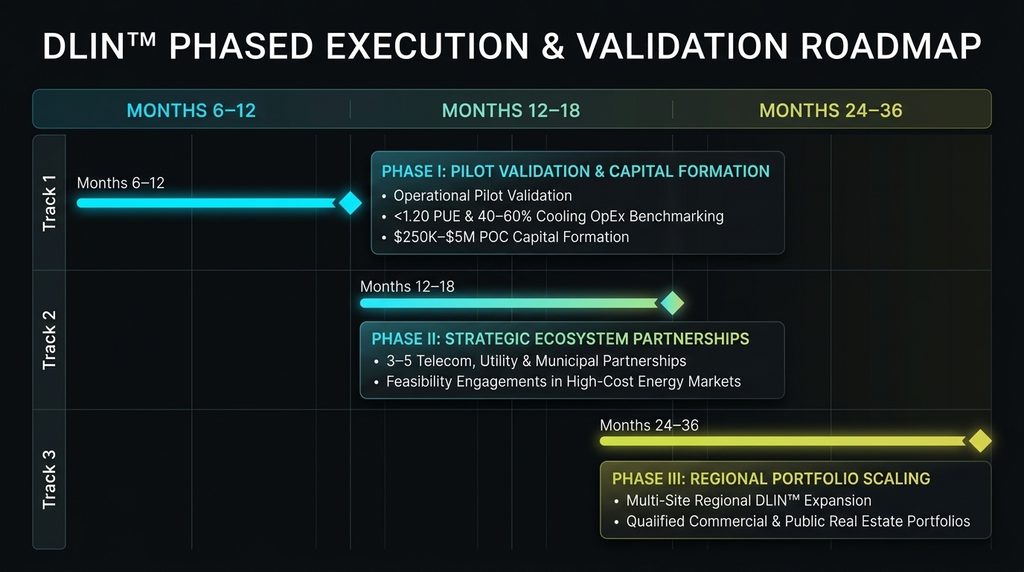
DLIN™ Phased Execution & Validation Roadmap Gantt
As of 2026
DLIN PHASED EXECUTION & VALIDATION ROADMAP:
Phase I: Months 6–12 Pilot Validation and Capital Formation (<1.20 PUE, 40–60% cooling OpEx benchmarking, $250K–$5M POC capital),
Phase II: Months 12–18 Strategic Ecosystem Partnerships (3–5 telecom, utility, and municipal partnerships)